
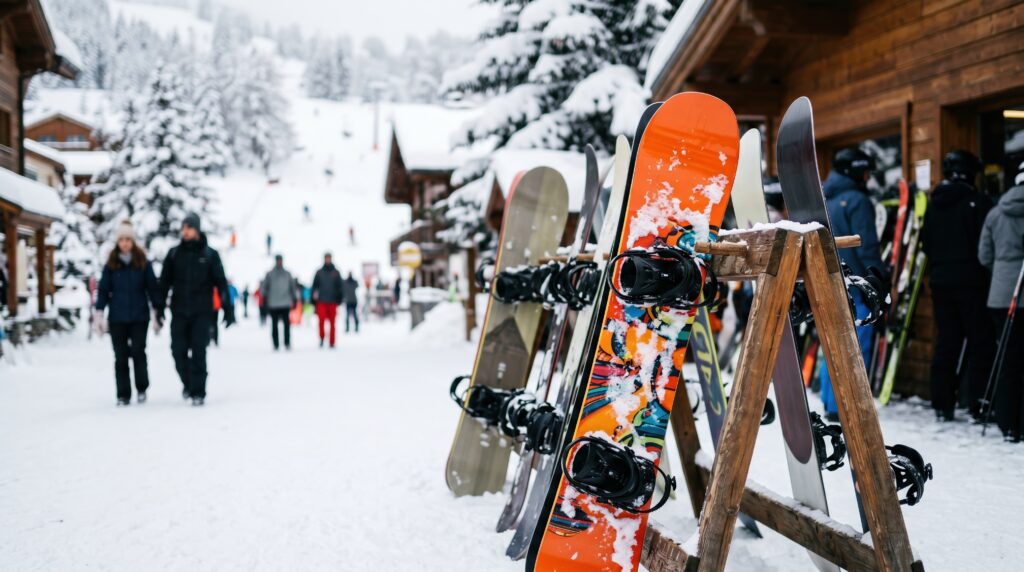
Opening weeks at Vail are their own thing. The mountain is technically open, the lifts are running, and if you have been waiting since April, that is reason enough to be there. But early-season Vail is not late-January Vail. Coverage is thinner and firmer. A lot of what you are riding in November has been shaped by snowguns rather than storms. Terrain is limited to what has been built out and groomed to a skiable base. None of that is a dealbreaker. It just means the equipment that makes sense in March is not necessarily the equipment that makes sense in November, and if you are a snowboarder planning a Vail trip this fall, understanding that difference is worth a few minutes before you book anything.
What Opening Weeks in Vail Actually Look Like
Early-season Vail rewards riders who show up knowing what to expect. Groomed runs are fast and consistent. The machine-made base sets up firm in the morning and softens through midday as traffic and sun do their work. You are not going to find much soft snow off the groomed lines, and the terrain that opens first is the terrain that can be built up and managed most reliably, which means wide groomers and beginner and intermediate runs before the back bowls and steeper terrain come into play.
For a snowboarder, that translates to a specific kind of riding: edge-to-edge carving on groomed blue and green runs, long top-to-bottom laps, and the kind of mellow exploration that suits riders who are finding their legs after a summer off the snow. It is a genuinely good time to be at Vail. It is also a genuinely good time to be on a board that was built for that kind of snow rather than the one you have been eyeing at the shop all summer.
Why Early Season Is the Best Time to Ride Someone Else’s Board
If you just bought a new board, early-season Vail is the worst possible place to put it through its first real runs. Machine-made snow is harder on bases and edges than natural powder, and the firm morning conditions that characterize the first weeks of the season are exactly the conditions that put the most stress on a new deck. Riding your own new board on early-season groomers is a fast way to put it through more wear in a week than it would see in a full month of powder days. The smarter move is covered in more detail in the rent versus buy post on vailskishop.com, but the short version is that renting in early season is not a consolation prize. It is the right call for the conditions.
Board Shape and Flex: What Actually Suits Vail
The snowboard market has more shape and flex options than most riders need to think about, but narrowing it down for Vail’s terrain mix is straightforward.
An all-mountain board is the right choice for most riders visiting Vail. It is designed to perform across groomed runs, variable snow conditions, and the occasional excursion into ungroomed terrain, which is exactly what Vail’s terrain mix asks for across a full trip. All-mountain boards are typically directional or directional twin in shape, meaning they are designed to be ridden primarily in one direction with a slightly setback stance, and they handle firm groomed snow as well as softer conditions when the season progresses.
A freeride board is the choice for riders who are specifically chasing steeper terrain and variable snow conditions and who are experienced enough to use it. Longer, stiffer, and designed for high-speed riding and powder, a freeride board is excellent in the back bowls later in the season. In early November on groomed groomers, it is more board than the conditions call for.
A park board is built for the terrain park, with a twin shape and softer flex that makes it responsive for jumps, rails, and jibs. If the park is your destination, it is the right tool. If you are spending most of your time on groomed runs, a park board’s softer flex and twin shape work against you on carving runs.
For most riders visiting Vail on a September or October booking, an all-mountain board in the right size is the answer, and it is what American Ski Exchange carries across a range of sizes and performance levels for exactly this kind of trip.
Sizing Without the Guesswork
Snowboard sizing is less intimidating than it looks once you understand the variables. The four inputs that matter are height, weight, boot size, and riding style, and they interact in ways that a simple height-to-board-length chart does not fully capture.
Height gives you a starting range. A rider who is five feet ten inches tall will typically be looking at boards in the 155 to 160 centimeter range, but that range shifts based on the other inputs. A heavier rider needs a longer board for float and stability. A lighter rider can go shorter for easier maneuverability. Boot size affects the appropriate board width, because a board that is too narrow for your boot size will cause toe and heel drag on hard carves, which kills edge control and is the single most frustrating fitting error to discover on the mountain.
Riding style is the final input. A rider who prefers charging groomed runs at speed wants a longer, stiffer board that holds an edge at higher speeds. A rider who spends more time in the trees and variable terrain wants something shorter and more maneuverable that responds faster to direction changes.
When you reserve with American Ski Exchange, the fitting process accounts for all of these inputs rather than handing you the closest board on the rack to your height. That matters more than most riders expect, especially for a trip where you are riding conditions you do not ride every day.
Boots Are the Whole Game
Experienced riders say it every season and it remains true every season: the board is secondary. Boots determine how you feel at the end of the day, how precisely you can translate input into edge control, and whether the riding is something you want to do again tomorrow or something you are enduring.
Snowboard boots are sized differently from street shoes, and the difference is not trivial. Snowboard boots are designed to fit snugly enough that your heel is fully locked in the heel cup with minimal lift when you flex the boot forward. A boot that feels slightly too snug in the shop will pack out over the course of a day and feel right by the afternoon. A boot that feels comfortable in the shop will feel sloppy on the mountain by noon, and sloppy boots mean heel lift, which means reduced control and blisters.
Flex rating is the other boot variable that significantly affects how the board feels. A softer flex boot is more forgiving and easier to initiate turns in, which makes it appropriate for beginners and intermediate riders who are still developing their technique. A stiffer flex boot is more responsive and transfers energy to the board more precisely, which experienced riders prefer for carving and high-speed riding.
September and October are the best possible time to get boot fitting done. When you walk into American Ski Exchange before the season, the fitting process happens without the line, without the time pressure of a group waiting outside, and with full attention from the staff on getting your heel hold and flex right before you step outside. That is a meaningfully different experience from walking in at nine in the morning on a Saturday in December when every chair in the shop is occupied.
Bindings and Stance
Bindings connect your boots to your board and translate your movements into edge control, and the setup that comes out of the shop before you walk out matters more than most riders realize.
Stance width, the distance between your bindings, affects how stable and how maneuverable the board feels. A wider stance provides more stability at speed and on firm snow. A narrower stance allows more agility and easier turn initiation. Stance width is typically set based on shoulder width, with adjustments based on riding style and preference.
Binding angle, the degree to which your feet point forward or outward, is a personal preference that develops over time as a rider learns what feels natural. Most intermediate riders ride with positive angles on both bindings, meaning both feet point somewhat toward the nose of the board. More experienced riders sometimes ride with the back binding at a negative or zero angle for a more centered, symmetrical stance.
At American Ski Exchange, bindings are set up in the shop before you walk out, with stance and angle adjusted based on your input and the staff’s assessment of what suits your riding style and the terrain you have described. If the setup does not feel right after your first runs, the mid-trip swap policy means you can come back and adjust without starting over.
Demo Boards: Who Should Upgrade
Demo boards are a tier above standard rental stock, typically the current season’s high-performance offerings from major brands. They ride noticeably differently from standard rental boards, with more precise edge hold, more responsive flex, and construction quality that makes a difference on firm early-season groomers.
The rider who benefits most from a demo board is the intermediate-to-advanced rider who rides enough to feel the difference and who is on a trip where they want to maximize performance rather than simply have a functional setup. If you ride fifteen or more days a season and you know what you like, a demo board is worth considering for a Vail trip.
For riders who are still developing their skills, a standard rental board in the right size and flex is the better choice. The performance difference between a standard rental and a demo board is less noticeable when you are still working on fundamental technique, and the price difference is better spent elsewhere. For a full breakdown of what is available at each tier, the packages and rates page walks through current options.
What to Bring, What American Ski Exchange Provides
American Ski Exchange provides the board, boots, and bindings, set up and ready before you walk out. What you bring is everything else: helmet, goggles, gloves, base layers, and outerwear appropriate for early-season Vail temperatures, which can range from cold mornings to genuinely mild afternoons as November progresses.
A helmet is non-negotiable and is not included in the standard rental. If you do not own one, American Ski Exchange can point you toward options in Vail Village. Goggles matter on firm snow days when glare is more pronounced than on powder days. Gloves should be waterproof even in early season, because machine-made snow is wetter than natural snow and your hands will be in it.
Picking Up in Vail Village
American Ski Exchange is located in Vail Village, which puts it a short walk from the base of the mountain. The practical advantage of that location is that you are not carrying gear across a parking lot or shuttling from an off-mountain shop. You pick up, you walk to the lift, you ride.
Timing matters. Picking up the evening before your first day eliminates the morning rush and lets you start your first day without standing in a line while everyone else is trying to do the same thing. Overnight storage after your last run means you are not hauling the board back to wherever you are staying. If the board is not right after your first morning, mid-trip swaps are available at no additional charge, which means the fitting decision you made in the shop is not final if the mountain tells you something different.
Reserving in September, before the season fills in, means the performance boards and the specific sizes that sell out first are still available. The group rentals page covers coordination for mixed ski-and-snowboard groups where getting everyone sorted before arrival makes the first morning significantly smoother.
Frequently Asked Questions About Snowboard Rentals in Vail
Do I need to reserve a snowboard rental in advance for early season at Vail?
Reserving before you arrive, especially in September and October when the good boards and specific sizes are still fully available, gives you the most options and eliminates the morning pickup line on your first day. Walk-ins are accommodated, but popular sizes and demo stock move quickly as the season fills in.
What is the right board size for a first-time renter?
Board size depends on your height, weight, boot size, and riding style rather than a single measurement. The fitting process at American Ski Exchange accounts for all of these inputs. If you are uncertain, sharing your height, weight, and boot size when you reserve gives the staff a starting point before you arrive.
Can I swap my board mid-trip if it does not feel right?
Yes. Mid-trip swaps are available if the board you picked up is not working for you after your first runs. This is one of the practical advantages of renting from a shop in Vail Village rather than committing to a board for the full trip without recourse.
What is the difference between a standard rental board and a demo board?
Demo boards are current-season high-performance models that ride with more precise edge hold and more responsive flex than standard rental stock. The difference is most noticeable for intermediate-to-advanced riders who ride enough days per season to feel the distinction. For riders who are still developing their technique, a properly fitted standard rental is the better starting point.
How early should I pick up my rental before my first day?
Picking up the evening before your first day eliminates the morning rush and lets you start riding without a delay. American Ski Exchange’s overnight storage means you are not carrying the board back to your accommodation after your last run.
How do I reserve a snowboard rental at American Ski Exchange?
Visit vailskishop.com to review available packages and reserve ahead of your trip. The FAQ page covers common questions about the pickup process, what is included, and how mid-trip swaps work.
Show Up Ready, Not Figuring It Out on the Lift
The riders who get the most out of early-season Vail are the ones who showed up knowing what the snow would be like, chose their setup accordingly, and handled the logistics before opening day rather than on it. A properly fitted board in the right shape and flex for groomed early-season terrain, boots with real heel hold, and bindings set up before you walk out of the shop are the difference between a trip that clicks from the first run and one that spends a day and a half correcting course. Contact American Ski Exchange to reserve your setup before the season fills in.